Your rating moved. You don’t know why yet.
The way it usually goes
You open Google. Last month it said 4.8. Now it says 4.6. You scroll through the recent reviews looking for the reason. One mentions wait times. One mentions a new staff member. One is just a vague complaint with no specifics.
You make a guess. Monday’s team meeting talks about “improving reviews” generically. The guess becomes the plan. The plan moves the needle, or it does not, and you will not know until next month.
This is how most owners read their rating. It is not a failure of effort — it is the absence of a tool that reads patterns instead of individual reviews.
How Pinn does it
Four steps between a connected profile and the causal picture of your reputation.
- 01
Pinn reads every review on your Google Business Profile
The moment you connect your business, Pinn ingests every existing review and every new one as they arrive. Your full review history becomes the data layer.
[Review ingestion stream]Every review, every profile, on a rolling feed. - [Theme extraction per review]
Themes distributed into vertical-specific buckets. 02Reviews are categorized by theme — tuned for your industry
Pinn extracts the themes in each review: wait times, staff, specific services, pricing, cleanliness. The theme vocabulary is tuned for your business type, so “long wait” means something different for a dental practice than a restaurant.
- 03
Rating drivers are traced — which themes actually moved your score
Pinn correlates theme distribution with rating changes over time. You see which themes drove recent movement, which stayed stable, and which are emerging as future signals — with the specific reviews behind each pattern.
[Rating-driver correlation chart]Themes ranked by their causal impact on the score. - [X-Ray dashboard + Monday brief]
Drivers panel and Monday-morning brief, in one place. 04The full picture lives in your X-Ray and weekly brief
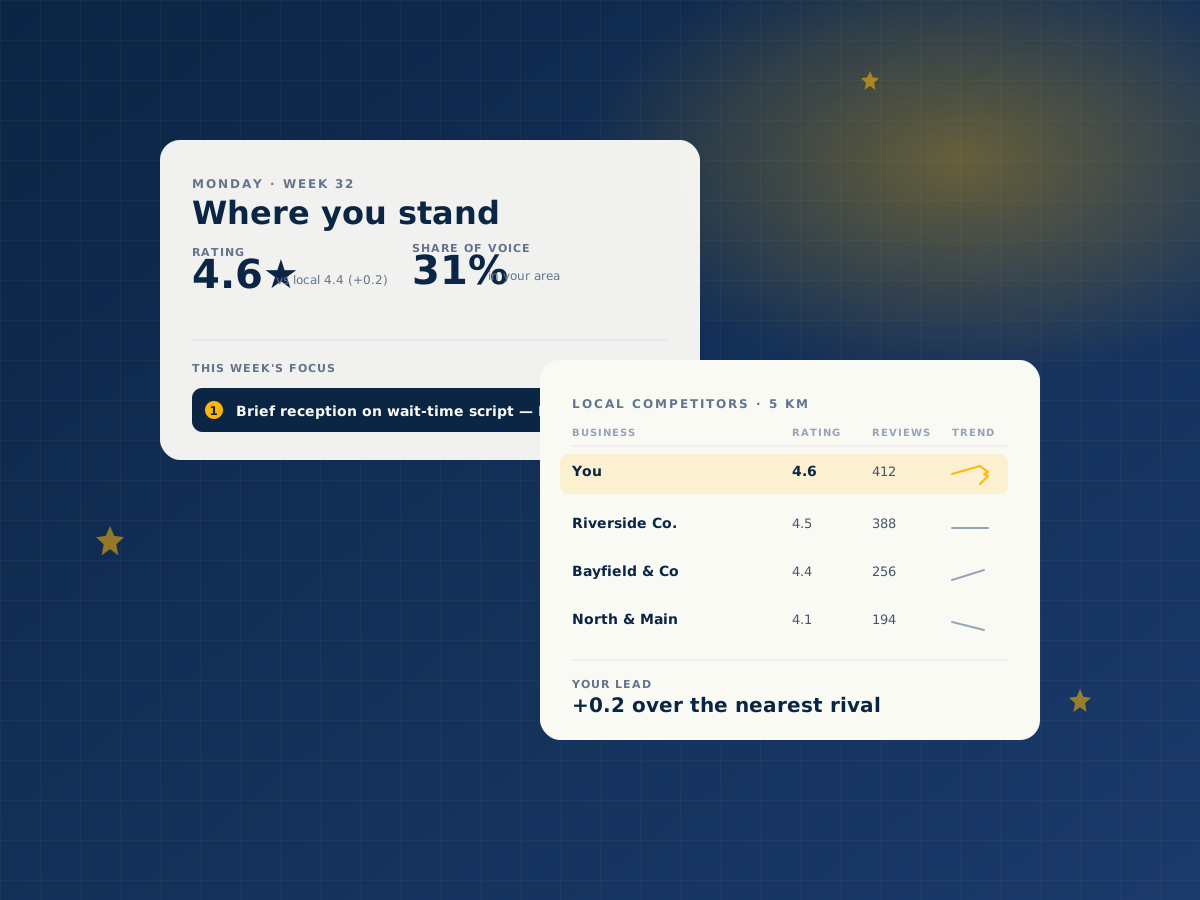
Your Business X-Ray updates daily with the latest theme and driver analysis. Every Monday, you get a 300-word brief summarizing what changed, why, and what to do next — delivered before your week starts.
What this looks like
The same Monday morning, read two different ways.
Without Pinn
You open Google. You scroll through reviews. You see fragments — a complaint, a compliment, another complaint. You make a guess about what is moving the needle. Monday’s team meeting talks about “improving reviews” generically. You will not know if the plan worked until next month.
With Pinn
You open your X-Ray. The drivers are ranked. The themes are named. The reviews behind each pattern are linked. Your Monday brief is already in your inbox with the specific action for the week.
Monday’s team meeting has a name, a number, a window, and a decision. The guess is gone.
This is what reading reviews actually looks like — not scanning, not guessing. Reading.